
How it works
Read these pages in order. Each one is short, has a numbered sequence diagram whose numbers match its prose, and ends with what is proven live and where the code is.
- The agent asks: the AI connects over OAuth and calls MCP tools. It can create requests, never signatures.
- Policy decides: your rules for that agent, evaluated before your phone rings: deny, ask you, or (outside Cardano) allow within limits.
- Your passkey signs: you review the payment, your passkey signs the exact bytes, and the server checks that nothing changed.
- Paying with x402: the seller quotes in an HTTP 402; ZyroPay builds the Cardano transfer and hands it back through the agent.
- Escrow with Masumi: the payment waits in a Plutus script until the seller delivers, and can be refunded.
- Proof before release: the seller’s on-chain result hash against what your agent received.
- Delivery receipts: the seller’s signature over the exact bytes it sent.
- Discover and identify: finding sellers in the Masumi registry and checking a claimed identity on chain.
- Agents hiring agents: a seller pays another seller, and the receipts chain.
- Autonomous mode: payments without you, what bounds them, and why Cardano is excluded.
The life of one request
Section titled “The life of one request”Every payment, from an agent or from you in the app, is one transaction request that moves through a fixed state machine. An illegal transition throws, and each change is checked against a version number, so a step can never be skipped and two approvals can never both sign.
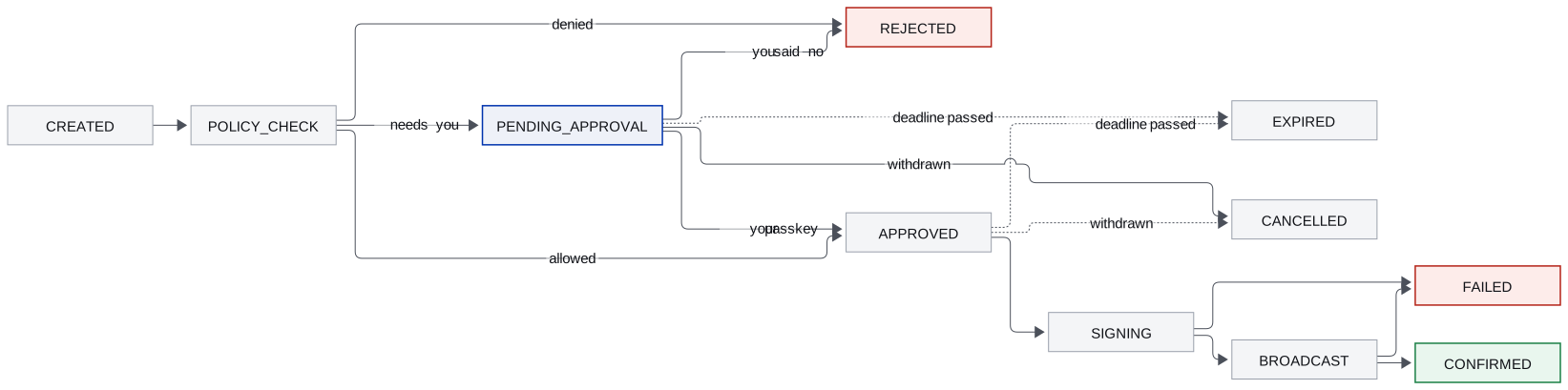
| End state | Means |
|---|---|
CONFIRMED |
The chain confirmed it; the reserved amount moved to the spending ledger |
REJECTED |
You said no, or a policy rule denied it |
EXPIRED |
Nobody decided in time; a one-minute cron sweep moves it and releases the reservation |
FAILED |
The chain or a check refused it after signing started |
CANCELLED |
Withdrawn before signing began |
Once a request reaches SIGNING, only the chain decides the outcome: it cannot expire or be
cancelled any more, because a signature may exist.
An x402 payment on Cardano is the one variation: after you approve, the API does not broadcast. It
attaches your signature and waits for the agent’s next status call to hand the payment to the
seller, whose facilitator submits it (step 4). The transaction id (the
body hash) is known before submission, so the request moves to BROADCAST at hand-off and the
confirmation tracker follows that id to CONFIRMED, exactly as for a send it broadcast itself. If
the validity window passes and the transaction never lands, it ends FAILED and the reservation is
released. Handing the same signed bytes over twice cannot pay twice: their inputs can be spent once.