
5. Escrow with Masumi
A direct x402 payment pays the seller before you know what you will get. With escrow, the money goes
to Masumi’s payment-v2 vested_pay script (Plutus V3) instead. The seller collects it only after
recording a result hash on chain and waiting until an unlock time; until then you can ask for a
refund. x402 carries this as assetTransferMethod: "masumi": the 402’s payTo is the escrow
script, and the seller signs the terms.
ZyroPay only ever locks into the canonical deployment:
addr_test1wzs4e6wc95hkwezlccjw9mdvq0r0rsgx6zk34avptga3ftgn37w4g on preprod, with 2-of-3 admins
for disputes and a 7-minute cooldown between actions.
Choosing escrow
Section titled “Choosing escrow”pay_x402 takes escrow:
true: pay into escrow (the 402 must offer themasumimethod);false: pay directly;- omitted: escrow when the 402 offers it and the agent’s policy sets an escrow threshold
(
x402EscrowAboveUsdMinor), otherwise direct.
With a threshold set, a direct x402 payment valued above it, or with no valuation, is treated like an
over-limit request (ESCROW_REQUIRED): it comes to you, or is denied if you chose that. A threshold
of 0 means every x402 payment must use escrow.
From quote to lock
Section titled “From quote to lock”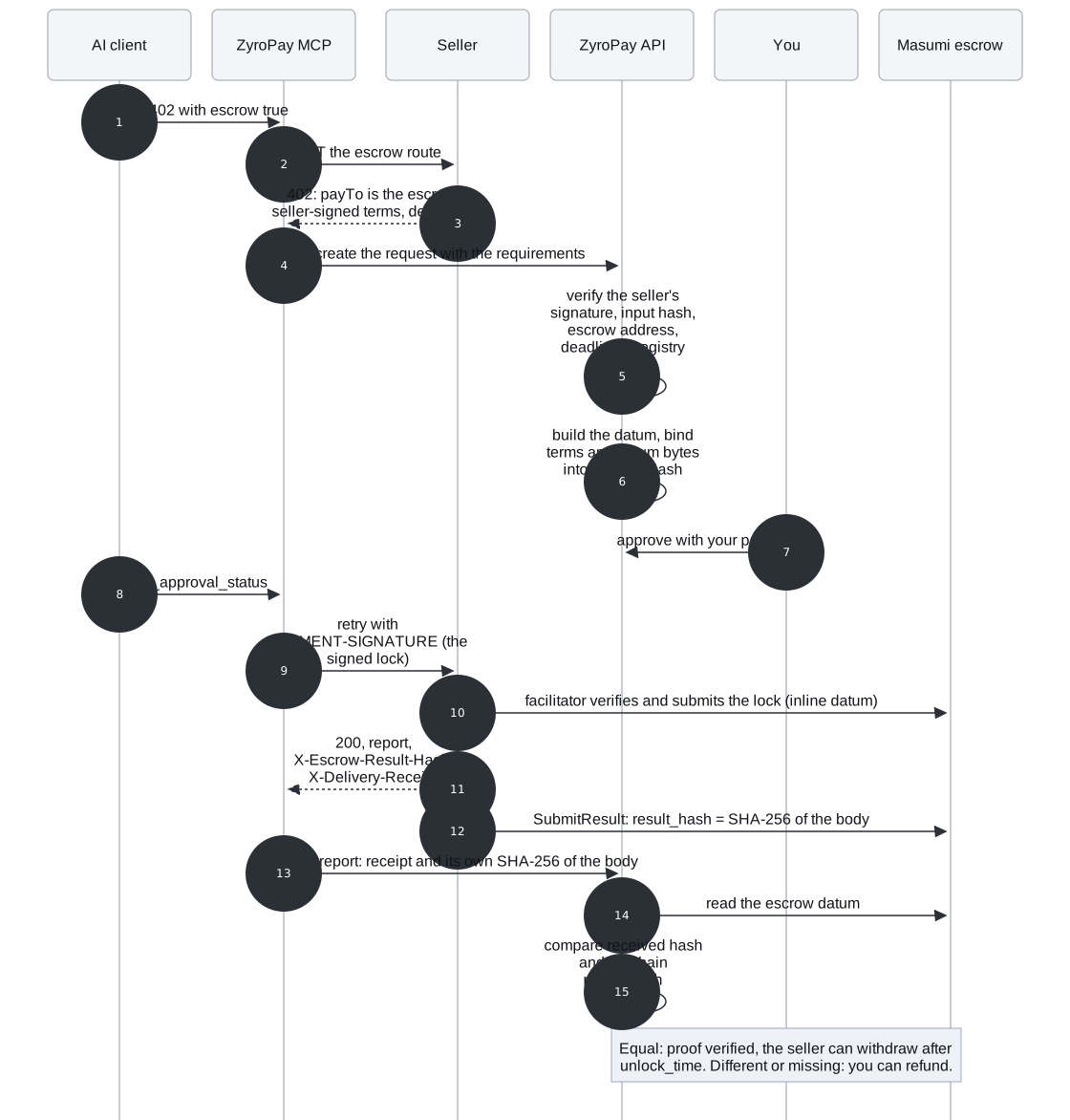
- The agent calls
pay_x402withescrow: true. - The MCP worker requests the seller’s escrow route.
- The seller answers
402:payTois the escrow script,extracarries the terms signed by the seller’s key (CIP-8 / COSE over the terms digest), the input commitment and the deadlines. - The worker passes the requirements to the API.
- The API verifies, with
@x402/cardano2.29’s own functions plus its own rules: the seller’s signature over the terms; the recomputed input hash;payToequal to the derived canonical escrow address; the deadline order and a 30-day horizon;payByTimeat least 60 s away and withinmaxTimeoutSeconds; a commitment that names the paid URL; and, if the seller claims a registry identity, that identity on chain. Any failure refuses the payment. - It builds the datum and the exact locked lovelace (with live
coinsPerUtxoByte), round-trips the datum field by field, and puts the terms and the exact datum bytes into the payload, so your approval commits to them. - You approve with your passkey.
- The agent’s next
get_approval_statuscall picks up the signed lock. - The MCP worker retries the URL with it in
PAYMENT-SIGNATURE. - The seller’s facilitator checks the lock (one inline-datum output to the escrow, exact value,
datum equal to the signed terms, validity ending by
payByTime) and submits it. - The seller answers
200with the report,X-Escrow-Result-Hashand a delivery receipt. - The seller records
result_hash = SHA-256(body)on chain with SubmitResult. - The MCP worker reports what it received: the receipt and its own SHA-256 of the body.
- The API reads the escrow’s datum from the chain.
- It compares the two hashes: that is proof before release.
The lock transaction has one output to the escrow with the inline datum and exactly the locked value,
plus change to you. Its validity ends at payByTime, rounded down to a slot, and the request itself
expires at payByTime. No script runs at lock time, so the lock’s rules are checked off chain, by
ZyroPay’s verifier and by the facilitator’s.
The escrow’s life
Section titled “The escrow’s life”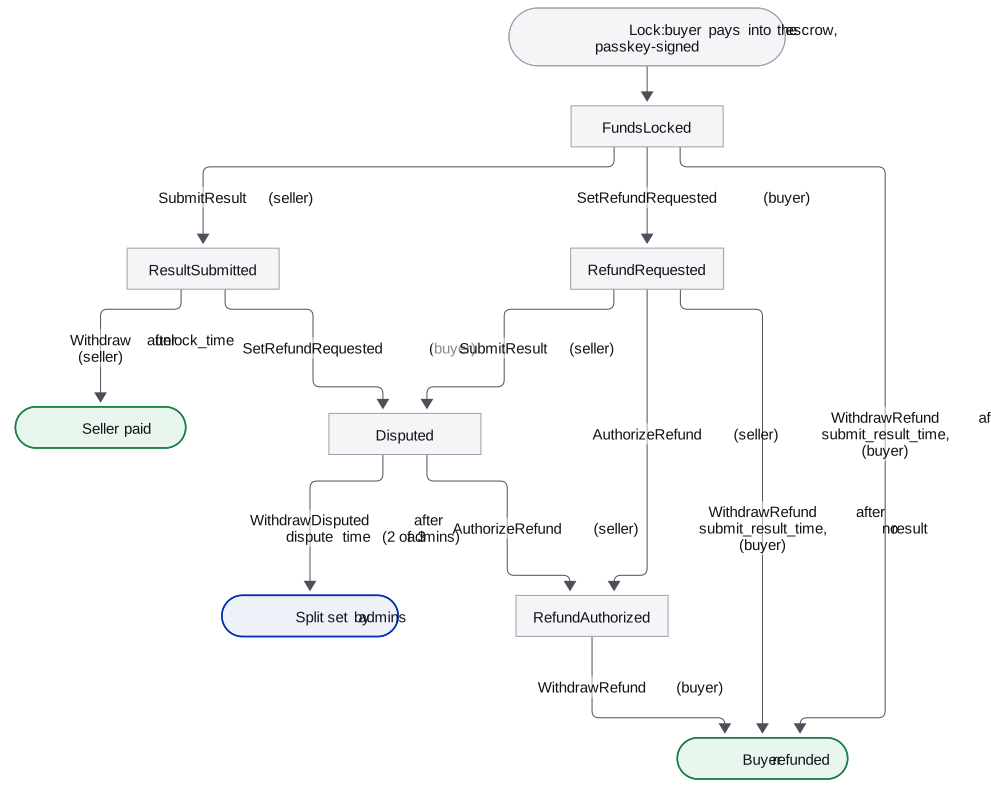
| Deadline (from the seller’s 402) | Demo seller default | After it |
|---|---|---|
payByTime |
402 time + 5 min | The lock can no longer land |
submitResultTime |
payByTime + 10 min |
Without a result, you can withdraw your refund on your own |
unlockTime |
submitResultTime + 15 min |
With a result and no refund request, the seller can withdraw |
externalDisputeUnlockTime |
unlockTime + 15 min |
The admins (2 of 3) can settle a dispute |
The live lock below carries exactly these: payBy 16:28:38, submitResult 16:38:38, unlock 16:53:38 and dispute 17:08:38 UTC.
Getting a refund
Section titled “Getting a refund”In the app, an escrow payment shows its state from the chain, the deadlines and the refund action that is open to you. Both buyer actions are script spends signed with your passkey:
- Request refund (SetRefundRequested). Possible while the funds are locked. Before a result it
moves to
RefundRequested; after a result it moves toDisputed. The demo seller’s sweeper authorizes refund requests automatically (AUTO_AUTHORIZE_REFUNDS, its preprod demo policy). - Withdraw refund (WithdrawRefund). Possible once the seller has authorized the refund, or after
submitResultTimeif no result was ever submitted. After a result, a refund needs the seller’s authorization or the admins.
For each, the API builds the spend, has Blockfrost evaluate the script and adds a 20 % margin to the measured units, sets the continuing datum (your cooldown is the validity end plus 420 s), and returns a review whose payload is the spend’s body hash. On submit it re-verifies the spend against fresh protocol parameters, re-reads the escrow output, checks the stamp like an approval, claims the build by compare-and-set (one signature per build), then attaches the witness and submits. A refund spend needs a pure-ADA output in your wallet for Plutus collateral.
How the seller gets paid
Section titled “How the seller gets paid”Right after answering, the seller’s worker waits up to about 20 s for the lock, builds SubmitResult
with the Evolution SDK, has Blockfrost evaluate it, signs with its key and submits. A cron sweeper
runs every minute: it retries a pending SubmitResult, withdraws once chain time passes unlockTime,
and authorizes refund requests. The seller pays the fees of its spends (about 0.7 ADA each, with the
10 KB script inline) and needs its own collateral. Before it pays a fee for any output at the escrow
address, it checks that the datum names it as seller, that at least 4 tADA is locked and that there is
no reference script, because anyone can create an output at a script address.
Why at least 4 tADA: the escrow output must still clear the minimum UTxO value once the result hash is in the datum (about 3.7 tADA). At 4 tADA or more the buyer’s collateral return is 0 and the lock is exactly the price. The demo seller charges 5 tADA on its escrow route.
Proven live
Section titled “Proven live”An AI agent paid the escrow route of the demo seller: 5 ADA locked, about 130 s from the request to the lock including the human approval.
Open 630f20122b…43c653 on Cardanoscan (preprod) and check:
| Where | What you should see |
|---|---|
| Output #0 | Exactly 5 ADA to the Masumi V2 escrow script addr_test1wzs4e6…37w4g, with an inline datum |
| Datum: buyer | Payment key hash 25a18eb6… (the user's address) |
| Datum: seller | Payment key hash cb4ab9d1… (the seller's address) |
| Datum: state | FundsLocked (constructor 0), result_hash empty |
| Datum: deadlines | payBy 16:28:38, submitResult 16:38:38, unlock 16:53:38, external dispute 17:08:38 (UTC) |
| Validity | TTL = payBy rounded down to a slot (137694518) |
| Output #1 | Change to the user; no script runs at lock time |
| Fee | 0.187589 ADA (731-byte transaction) |
The seller’s SubmitResult followed 21 s later, in the next block: ee7b142e73…865361 (block 5353820, fee 0.688128 ADA). Its checks are on Proof before release.
The seller’s cron sweeper then collected the escrow 39 s after unlockTime, on its own, with the
Withdraw redeemer. That closes the honest lifecycle: lock, SubmitResult, Withdraw, each spending the
output the one before created.
Open c59d85cf3b…b916d3 on Cardanoscan (preprod) and check:
| Where | What you should see |
|---|---|
| Input | The escrow UTxO ee7b142e…5361#0 (5 ADA at the script, state ResultSubmitted) |
| Script | One Plutus V3 spend of the vested_pay script a15ce9d8…14ad, redeemer Constr 0 [] (Withdraw) |
| Output #0 | 4,357,634 lovelace to the seller addr_test1qr954…kaen; no output back to the escrow |
| Validity | Starts at slot 137696019, after unlock_time (16:53:38 UTC): the script only allows Withdraw then |
| Signer | The seller's payment key (cb4ab9d1…), the key the datum names |
| Fee | 0.642366 ADA (10,450-byte transaction, the script inline, paid out of the escrow) |
Awaiting a live run: a refund (request and withdrawal) Awaiting live run. It is covered offline
Tested offline, together with the rest of the state chart: lock, refund request, seller
authorization, withdrawal, refunded; withdrawal after the deadline; the seller collected; a forged
body hash or stamp refused and audited; one signature per build
(apps/api/test/integration/x402-masumi.test.ts, escrow-chain.test.ts, and the lock checked by
the facilitator’s own verifyMasumiLock in
packages/integrations/src/__tests__/x402-masumi.test.ts).
Code: packages/integrations/src/masumi.ts, packages/blockchain/src/cardano/escrow.ts,
apps/api/src/services/escrow.ts, apps/api/src/services/escrow-view.ts, apps/seller/src/escrow/.