
7. Delivery receipts
A paid HTTP response proves nothing by itself: anyone on the path could have produced it. A
delivery receipt ties the bytes to the party that was paid. The seller signs, with the Ed25519
key behind its payTo address, a message naming the paid URL, payTo, the payment transaction and
the SHA-256 of the exact response body. Only the holder of that key can make a receipt that verifies.
The format (v1)
Section titled “The format (v1)”Header X-Delivery-Receipt: base64 of
{v:1, resourceUrl, payTo, paymentTx, contentSha256, signedAt, publicKey, signature}.
contentSha256: hex SHA-256 of the exact response body bytes.paymentTx: the settled transaction id fromPAYMENT-RESPONSE(ornull).publicKey: the 32-byte Ed25519 verification key ofpayTo’s payment credential.signature: Ed25519 (64 bytes, hex) over the UTF-8 message
"zyropay-x402-receipt-v1\n" + resourceUrl + "\n" + payTo + "\n" + (paymentTx ?? "") + "\n" + contentSha256 + "\n" + signedAtVerification
Section titled “Verification”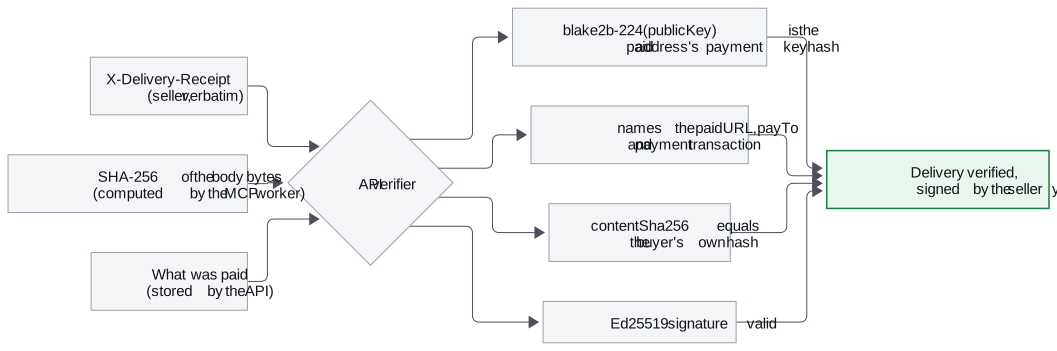
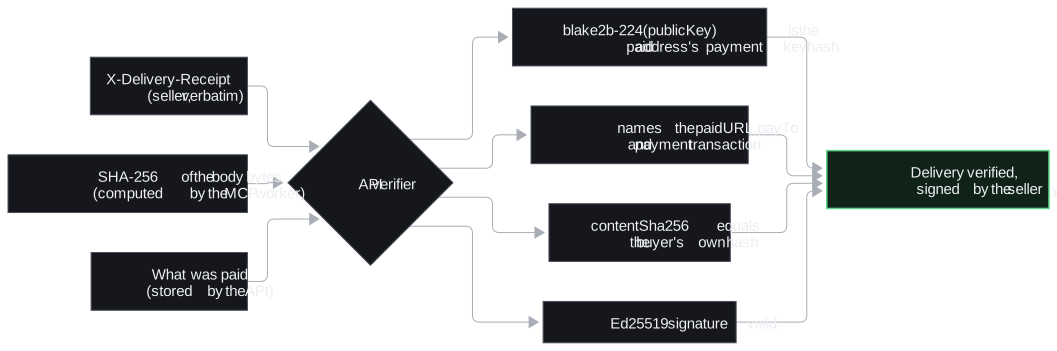
The MCP worker forwards the header verbatim (it never parses it; above 4 KiB it is dropped) together with its own SHA-256 of the body it read. The API then checks, independently of both:
- Blake2b-224 of
publicKeyis the payment key hash of the address that was paid. For an escrow payment, that is the seller’s address in the signed terms, not the script. - The receipt names the bound resource URL, that
payToand the signed transaction. contentSha256equals the MCP worker’s hash. The seller’s own hash is never trusted alone.- The signature is valid.
The app then shows Delivery verified · signed by the seller you paid, or a warning with the reason;
the agent gets the verdict in resource.receipt (verified, contentSha256, signedBy, signedAt,
reason). A failed receipt is audited as security.x402_receipt_invalid. A receipt problem never
fails the paid request itself: you paid, and the response is delivered either way.
| Reason | Means |
|---|---|
missing |
The resource sent no receipt |
malformed |
The header is not a v1 receipt |
body_unavailable |
The buyer could not hash the full body (truncated or not text) |
unsupported_network |
Receipts are verified for Cardano payments only |
wrong_signer |
The signing key or payTo is not the address that was paid |
wrong_resource |
Signed for another resource URL |
wrong_payment |
Signed for another payment transaction |
content_mismatch |
The delivered bytes are not the ones the seller signed |
bad_signature |
The signature does not verify |
Receipts and escrow
Section titled “Receipts and escrow”For an escrow payment, the result hash on chain is SHA-256(body), the same value the receipt signs
as contentSha256. The receipt, the chain and the buyer’s own measurement can therefore be compared
three ways; that comparison is proof before release. For a direct payment
nothing is recorded on chain and the receipt is the only evidence (proof state receipt_only).
Proven
Section titled “Proven”Live: the direct x402 payment’s receipt verified 83ecc5742f…9d787b (block 5353756, fee 0.167349 ADA). Offline
Tested offline: valid receipts verify; a wrong key, other bytes, another URL, another
payment, a malformed header and a forged signature each fail with the reason above
(apps/api/test/integration/x402-cardano.test.ts, packages/shared/src/x402-receipt.test.ts,
apps/seller/test/receipt.test.ts).
Code: packages/shared/src/x402-receipt.ts, apps/seller/src/receipt.ts.